
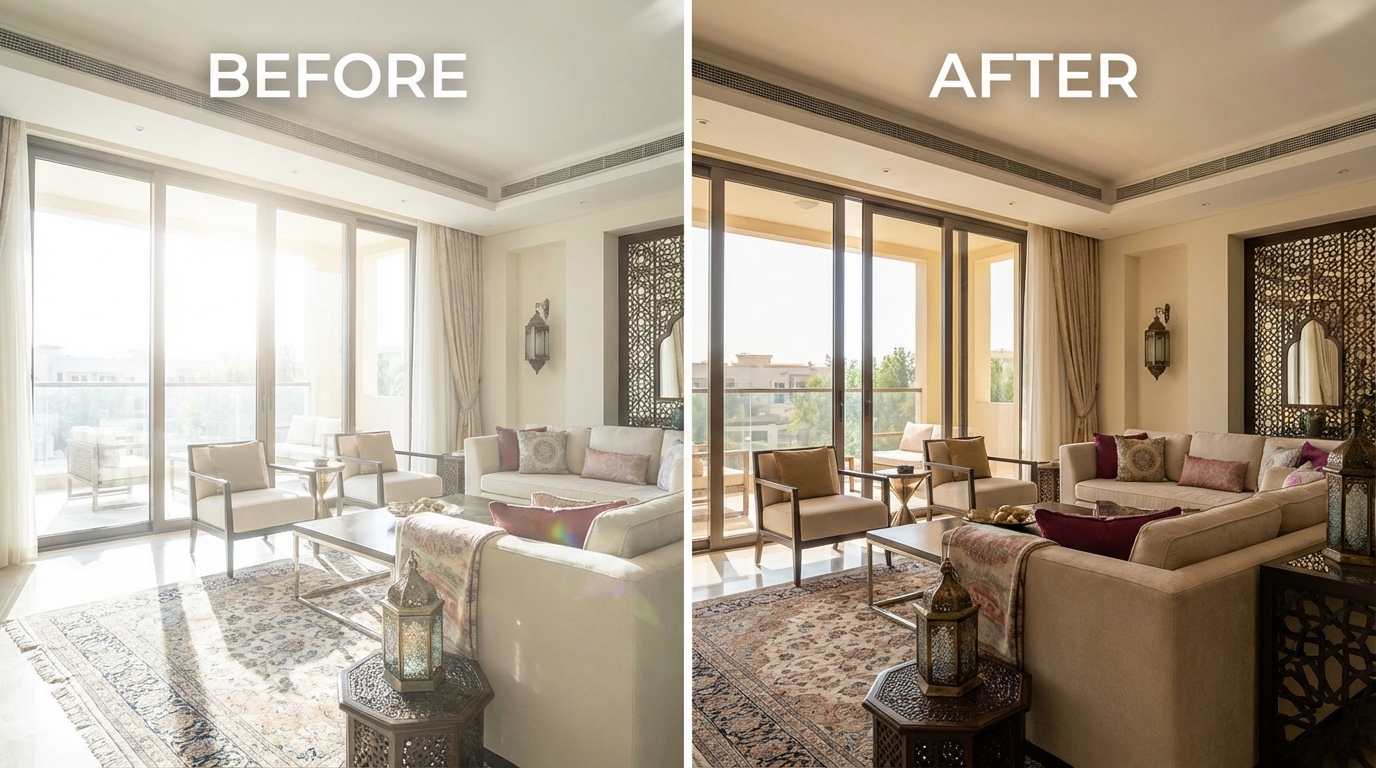
Heat & UV Protection
Heat Rejection Window Film UAE | Ceramic Film Blocks 85% Solar Heat From AED 130/sqm
Block up to 85% of solar heat and 99% of UV rays without darkening your rooms. Professional heat rejection window film installation across Dubai, Abu Dhabi, Sharjah and Ajman.
Living in the UAE means dealing with some of the most extreme solar heat on the planet. During summer months, untreated glass windows can allow surface temperatures to exceed 70 degrees Celsius on the interior side, turning your home into a greenhouse and forcing your air conditioning to run at maximum capacity around the clock.
Ceramic and sun control window films address this problem directly. Applied to the interior surface of your existing glass, these films reject up to 85% of solar heat and block 99% of harmful UV radiation. Unlike older dyed or metallic films, modern nano-ceramic technology achieves this without darkening your view, interfering with mobile signals, or altering the exterior appearance of your property.
Whether you live in a villa on the Palm, an apartment in Downtown Dubai, or a townhouse in Abu Dhabi, heat reduction film is the single most cost-effective upgrade you can make to reduce energy consumption, protect your interiors, and improve daily comfort. The International Window Film Association recognises window film as one of the most efficient retrofit solutions for reducing solar heat gain in existing buildings.
Up to 85% Heat Rejection
Nano-ceramic particles block infrared heat before it enters your home. Rooms stay noticeably cooler even with direct sun exposure.
99% UV Protection
Virtually eliminates ultraviolet radiation that causes furniture fading, hardwood discolouration, and skin damage from indoor sun exposure. The Skin Cancer Foundation recommends window film as an effective UV protection measure.
25-35% AC Savings
Less heat entering your home means your air conditioning works less. Most homeowners see measurable savings on their DEWA bills within the first month.
Glare Reduction
Reduce harsh glare on screens and surfaces without closing blinds. Work from home, watch television, and relax in comfort at any hour.
Furniture & Flooring Protection
UV blocking prevents the gradual fading and cracking of leather sofas, wooden floors, artwork, and soft furnishings exposed to sunlight.
Optical Clarity Preserved
Modern ceramic films maintain crystal-clear views. No haze, no colour distortion, and no impact on how your windows look from outside.
How Ceramic Window Film Works
Ceramic window film uses nano-ceramic particles embedded within multiple layers of optically clear polyester. Unlike older metallic films that relied on reflective metal layers to bounce heat away, ceramic technology absorbs and dissipates infrared energy without creating a mirror-like appearance or interfering with electronic signals.
The film is applied to the interior surface of your existing windows using a pressure-sensitive adhesive. Once cured, it becomes virtually invisible. The ceramic particles selectively target infrared wavelengths - the portion of the solar spectrum responsible for heat - while allowing visible light to pass through largely unaffected. This means your rooms stay bright and your views stay clear, even with a high-performance heat rejection film in place.
In practical terms, a south-facing window that previously turned your living room into a sauna will feel dramatically different within hours of installation. The glass itself stays cooler to the touch, the air temperature near the window drops significantly, and your AC unit cycles less frequently.
Nano Ceramic vs Standard Sun Control Film
Not all heat reduction films are created equal. Standard dyed films darken the glass and fade over time, losing their heat-rejection performance within a few years. Metallic films reflect heat effectively but create a mirror finish that many communities and landlords prohibit, and they can disrupt Wi-Fi, GPS, and mobile phone signals indoors.
Nano-ceramic film avoids all of these drawbacks. The ceramic particles are non-metallic and non-conductive, so there is zero signal interference. They do not fade or degrade under prolonged UV exposure, maintaining their rated performance for the full warranty period. And because the technology works through absorption rather than reflection, the exterior appearance of your glass remains unchanged - an important consideration for properties governed by HOA or community appearance guidelines.
For Dubai residents, nano-ceramic film is the clear choice. The combination of extreme heat, high UV index, and community aesthetic standards makes it the only film technology that ticks every box.
Want to know what Heat Reduction Film costs for your home?
Free on-site assessment. We reply within 30 minutes.
Energy Savings & Return on Investment for Dubai Villas and Apartments
Window film is one of the few home improvements that pays for itself. In the UAE, air conditioning accounts for roughly 60-70% of a typical household electricity bill during summer months. By reducing the solar heat load entering through your windows, ceramic film directly reduces the amount of work your AC system needs to do.
Most homeowners report a 25-35% reduction in cooling costs after installation. For a typical 3-bedroom villa in Dubai, this translates to annual DEWA savings of AED 3,000 to AED 6,000 depending on window area and orientation. DEWA's own cooling guidelines confirm that reducing solar heat gain through windows is one of the most effective ways to lower electricity consumption. At these savings rates, the film typically pays for itself within 18 to 30 months.
For villa owners specifically, the return on investment is particularly strong. Villas in communities such as Arabian Ranches, Dubai Hills Estate, and The Springs often have large west- and south-facing glass facades with minimal external shading. A full villa heat reduction installation covering 30-50 sqm of treated glass typically costs AED 7,500 to AED 18,000 and generates annual DEWA savings of AED 4,000 to AED 8,000. Payback in 18-30 months, followed by 10-12 years of savings. Our villa tinting Dubai page covers room-by-room glass prioritisation and the most common villa installation configurations across Dubai communities. For apartments, the same ROI logic applies at a smaller scale: a 2-bedroom apartment installation costing AED 2,500-5,000 typically saves AED 1,500-3,500 annually. See our home window tinting Dubai guide for a full apartment vs villa breakdown.
Beyond direct energy savings, there are secondary financial benefits. Your AC compressor runs fewer cycles, extending its lifespan and reducing maintenance costs. Your furniture and flooring last longer without UV-induced fading. And if you ever sell or rent the property, heat reduction film is a tangible upgrade that adds value.
Heat Reduction Film TSER Grades: What the Numbers Mean for Your DEWA Bill
TSER (Total Solar Energy Rejection) is the single most important specification for heat reduction film in Dubai. It measures the percentage of all incoming solar energy — infrared heat, UV radiation, and visible light combined — that the film blocks at the glass surface. The higher the TSER, the less solar energy enters your home and the less your AC has to run.
Here is what each grade level delivers in real Dubai conditions:
**40-55% TSER (entry-level solar control film):** Reduces room temperature by approximately 3-5 degrees Celsius on a west-facing window at peak afternoon. DEWA cooling savings are modest — typically 10-15% for treated rooms. These films are lightly tinted and may not provide a visible aesthetic change. Suitable for secondary rooms or north-facing glass where solar exposure is lower.
**60-70% TSER (mid-grade ceramic film):** The most common choice for UAE apartments. Reduces room temperature by 6-9 degrees Celsius. DEWA cooling savings of 20-28% for treated rooms. Visible light transmission of 40-55% VLT keeps rooms well-lit. A 2-bedroom apartment installation at this grade typically saves AED 1,500-2,500 annually.
**75-85% TSER (premium nano-ceramic):** The standard for Dubai villas and high-priority rooms. Reduces interior temperature by 10-14 degrees Celsius on south and west facades. DEWA cooling savings of 25-35% for treated rooms. With 50-65% VLT, rooms stay bright. For a 4-bedroom villa paying AED 30,000+ annually on DEWA, this grade generates AED 4,000-8,000 in annual savings. Payback period: 18-30 months.
The temperature reduction figures above are based on installations across villa communities including Arabian Ranches, Dubai Hills, and The Springs, measured using IR thermometers before and after installation on south and west facades under June-August conditions.
For the most efficient use of budget, apply 75-85% TSER film exclusively to south and west-facing glass (where solar gain is highest) and 60-70% TSER film to east-facing and less-exposed windows. This targeted approach captures 80-85% of the total available energy savings at 60-70% of the cost of a uniform premium installation. Our free site assessment maps every window by orientation and solar exposure to identify exactly which surfaces justify the premium grade. See our heat reduction window tint Dubai guide for a detailed TSER comparison with real DEWA savings data.
Installation Process & Compatibility
Professional installation takes one day for most villas and apartments. Our technicians measure each window, precision-cut the film, and apply it using a wet application method that ensures a bubble-free, smooth finish. The film cures fully within 7 to 14 days, during which minor water pockets may appear and disappear naturally.
Ceramic window film is compatible with virtually all glass types, including single-pane, double-glazed, low-E coated, and tempered glass. For double-glazed units, we conduct a thermal stress assessment to ensure the film grade is appropriate for your specific glass configuration. This prevents any risk of thermal cracking, a concern that only applies when the wrong film is paired with certain sealed units.
Once installed, the film requires zero maintenance. Clean your windows as you normally would. The film surface is scratch-resistant and will not peel, bubble, or discolour under normal conditions.
**UAE-specific installation considerations:** Dubai window glass reaches surface temperatures of 70 to 80°C in July and August, far higher than European climates for which many film adhesive systems are rated. We only use products with UAE-rated adhesives that remain stable at these surface temperatures without delaminating or creating edge lift over time. The UV index in Dubai reaches 10 to 11 from April through October, which degrades inferior polyester film at an accelerated rate. Professional-grade ceramic films are UV-stabilised specifically for high-index environments and carry 10 to 15 year manufacturer warranties with no pro-rata degradation clauses.
For a detailed step-by-step breakdown of what to expect before, during, and after installation (including how to prepare your windows, what questions to ask the installer, and how to verify the film is correctly applied), see our window film installation guide for UAE homes. For a clear overview of all film types available across the UAE residential market, our window film UAE guide covers each product category with performance data and AED pricing benchmarks. For a direct comparison of costs by film type and property size, see our window tinting cost Dubai guide.
Solar Window Film for UAE Homes — What to Expect
Solar window film is another name for sun control and heat reduction window film — the same core technology described throughout this page, also known as architectural film in commercial settings. The term "solar film" is commonly used across the Gulf region, and the products are identical: ceramic or nano ceramic films engineered to block solar heat and UV radiation at the glass surface.
Solar film for home use is available in the same ceramic and nano ceramic grades we install across all our residential projects. Depending on the grade selected, solar window film blocks 40 to 85% of solar heat while maintaining clear views and natural light transmission. The higher-performance nano ceramic grades sit at the top of this range, making them the preferred choice for UAE conditions.
South- and west-facing windows in UAE villas and apartments receive the most intense solar exposure and benefit most from solar window film installation. These orientations are where the heat gain is greatest and where the energy savings are most dramatic — typically reducing cooling costs by 20 to 35% for the treated rooms. For homeowners comparing products, the key specification to look for is TSER (Total Solar Energy Rejection), which measures the total percentage of solar energy the film blocks.
**How much will solar film actually save on your DEWA bill?** Based on installations we have completed across Dubai villa communities, the numbers are consistent: a typical 3-bedroom villa with south- and west-facing glass treated with 75% TSER nano-ceramic film reduces DEWA cooling costs by AED 3,000 to AED 6,000 annually. A 2-bedroom apartment with a treated west-facing sliding door and two bedroom windows saves AED 1,500 to AED 3,000 per year. The payback period on installation cost is typically 18 to 30 months, after which 8 to 12 years of savings follow before the film requires replacement. The Emirates Green Building Council lists window film among the most cost-effective retrofit measures for UAE residential buildings specifically because of this ROI profile.
For a full explanation of solar film grades, TSER ratings, and which products perform best in UAE summer conditions, see our dedicated solar film for home Dubai guide. For homeowners also researching whether blackout window film is right for specific rooms such as bedrooms and home cinemas, our blackout window film Dubai guide covers the overlap between thermal performance and full light blocking. For villa-specific solar film recommendations by community orientation, see our villa window tinting Dubai guide.
Heat Reduction Film by Room Type: Where It Makes the Most Difference
Not every room in a UAE home benefits equally from heat reduction film. The rooms that see the greatest improvement are those with large south- or west-facing windows and high sun exposure during the afternoon. Understanding which rooms to prioritise helps you make the most of your installation budget.
Living rooms with floor-to-ceiling glass or sliding doors facing west or southwest are the highest-priority surfaces in any Dubai or Abu Dhabi villa. These windows receive maximum solar exposure during the hottest part of the day, typically 1pm to 5pm in summer. Unprotected, a single 4-sqm west-facing sliding door can introduce as much heat as a small electric heater running continuously. Nano-ceramic film on these surfaces delivers an immediate, measurable improvement in thermal comfort and a 25-35% reduction in the cooling load for the affected room.
Bedrooms on upper floors with east-facing windows have a different heat problem: morning sun that overheats the room before the AC has a chance to compensate. For UAE residents who work from home or keep irregular schedules, this is a significant comfort issue. A moderate-grade ceramic film (50-60% TSER) on east-facing bedroom windows balances morning light with heat control, allowing the room to stay comfortable without drawing curtains.
Kitchens with south-facing windows face sustained heat exposure across the entire middle of the day. Combined with cooking heat, these rooms can become genuinely uncomfortable during summer. A high-performance film grade (70-85% TSER) on kitchen windows makes a practical difference to daily comfort and reduces the load on kitchen-area AC units that already work harder due to cooking activity.
Home offices and study rooms benefit from both the thermal comfort improvements and the glare reduction that ceramic films provide. Screen glare from direct sunlight is one of the most common complaints among UAE residents who work from home. A 50% VLT ceramic film significantly reduces glare while keeping the room bright enough to work comfortably without artificial lighting.
For a room-by-room assessment specific to your property, our free on-site consultation identifies the highest-priority surfaces and recommends film grades matched to each orientation and room type. See our heat rejection film for home guide for a full breakdown of what different performance grades deliver in real UAE conditions.
Heat Rejection Film for Home: How It Works in UAE Conditions
Heat rejection film for home use is the most impactful single upgrade available to UAE homeowners dealing with solar overheating. Unlike external shading structures that require construction or planning permission, heat rejection film for home installation is completed in a single day on your existing windows with no structural modification and no disruption to your home beyond the installation itself.
The way heat rejection film works in UAE homes is straightforward. Solar radiation consists of three components: ultraviolet (UV), visible light, and infrared (IR). UV and infrared together account for roughly 80% of the heat that passes through untreated glass. A nano-ceramic heat rejection film intercepts both at the glass surface — absorbing and dissipating the energy before it enters the room. The visible light component passes through largely unaffected, which is why heat rejection film for home applications can block up to 85% of solar heat while the room still looks bright and naturally lit.
For UAE villas and apartments, the heat rejection benefit is most pronounced in rooms where solar exposure is sustained and intense. A west-facing bedroom in Muwaileh, Sharjah that receives direct afternoon sun from 1pm to sunset can see interior surface temperatures drop by 10 to 14°C on treated glass compared to untreated glass under the same conditions. The AC does not have to compensate for that temperature differential, which translates directly to a reduction in compressor runtime and SEWA or DEWA billing.
Reduce heat window film UAE installations are available across all seven emirates. We install heat rejection film for home projects in Dubai, Abu Dhabi, Sharjah, Ajman, Ras Al Khaimah, Fujairah, and Umm Al Quwain. The film grade we specify for each project accounts for the local climate conditions, glass type (single pane, double-glazed, or low-E), and the priority orientation of the windows being treated. South and west facades always receive the highest TSER grade; less-exposed orientations can use mid-grade film without sacrificing meaningful performance.
For Sharjah homeowners specifically, heat rejection film for home installation is one of the most frequently requested services across Al Nahda, Muwaileh, and University City. Sharjah's mix of older single-pane villas and newer double-glazed apartments means the performance gap between treated and untreated glass is larger here than in newer Abu Dhabi developments with better-spec glazing. See our Sharjah window film page for community-specific pricing and scheduling. The International Window Film Association provides independently verified heat rejection performance data for the film grades we use across UAE residential projects.
Reduce Heat Window Film UAE: Northern Emirates and Villa Communities
Homeowners searching "reduce heat window film UAE" are typically dealing with one of three specific problems: a room that is too hot to use during afternoon hours, an AC bill that has grown beyond reasonable levels, or furniture and flooring that is visibly degrading from UV exposure. All three are solved by the same product — but the right film grade and application priority varies by property type and emirate.
For Dubai villas in Arabian Ranches, Dubai Hills, The Springs, and DAMAC Hills, the priority is almost always south and west-facing glass on the ground and first floors. These surfaces receive 6 to 8 hours of direct sunlight daily during the May through September peak. A 75-85% TSER nano-ceramic film on these specific windows delivers the largest reduction in AC load, reducing DEWA cooling costs for those rooms by 25 to 35%. Secondary rooms and north-facing windows can use mid-grade film at lower cost.
For Sharjah and Northern Emirates properties, the heat reduction imperative is equally strong but the property profile differs. Many homes in Sharjah's established neighbourhoods, Al Nahda, Muwaileh, and University City, were built before 2010 with single-pane or basic double-glazed windows. These windows have almost no thermal resistance beyond what the glass itself provides. Heat rejection film applied to these surfaces delivers a disproportionately large improvement in room comfort because the baseline performance is so poor. The combination of Sharjah's SEWA tariff increases and the relatively lower property values (where AC running costs represent a higher proportion of household income) makes the financial case for heat rejection film in Sharjah stronger than almost anywhere else in the UAE.
For Abu Dhabi properties on Saadiyat Island, Yas Island, and in Khalifa City, newer buildings with premium glazing still benefit from film because the UAE UV index reaches 10 to 11 from April through October, and even high-spec double-glazed units do not fully address UV radiation or infrared heat. A 70-80% TSER film on south- and west-facing glass in these developments reduces ADDC cooling costs and protects the high-value interior furnishings that are common in Abu Dhabi's premium communities.
For a detailed breakdown of how to reduce heat from windows across different UAE property types, see our guide to reducing heat from windows in the UAE and our best window film for heat UAE comparison. Both guides cover real performance data from installations across the region rather than manufacturer specifications alone.
What Is the Best Heat Reduction Window Film for Dubai?
The best heat reduction window film for Dubai depends on your priorities — but for most residential applications, nano-ceramic film in the 60-85% TSER range delivers the strongest combination of heat rejection, optical clarity, and long-term durability.
Nano-ceramic films outperform standard dyed and metallic films on every dimension that matters in the UAE. They do not degrade under sustained UV exposure, so the 75% TSER film you install today still delivers 75% TSER five years from now. They cause no signal interference — Wi-Fi, Bluetooth, GPS, and mobile all work normally through the glass. They reject heat by absorbing infrared energy rather than reflecting it, which means they have no mirror finish and will not conflict with community appearance guidelines.
For villa owners comparing specific products, the key specification to look for is TSER (Total Solar Energy Rejection) rather than VLT (Visible Light Transmittance) alone. TSER tells you what percentage of total solar energy — heat, UV, and visible light combined — the film blocks. A 75% TSER nano-ceramic film blocks three-quarters of all solar energy entering through the glass. This is the number that determines actual cooling savings.
For apartments in high-rise towers with factory-fitted double-glazed units, the film grade must be assessed against the glass specification to avoid thermal stress risk. Not every film is rated for every double-glazed configuration. Our free on-site survey includes a glass type assessment so the film we specify is compatible with your exact windows.
Our heat rejection film guide compares the main film grades in detail, including real-world DEWA savings data from Dubai villas. For a broader cost overview, see our home window tinting installation guide.
Heat Reduction Window Tint Dubai: Which Buildings Benefit Most?
Heat reduction window tint in Dubai works on any glazed building, but the return on investment varies by property type. Understanding where the performance difference is greatest helps you make the most of your budget.
Residential villas are the highest-return application for heat reduction window tint in Dubai. Large glass facades, south- and west-facing orientation, and the absence of external shading structures create extreme solar heat gain. A professionally installed heat reduction tint on a 4-bedroom villa typically reduces cooling costs by AED 4,000 to AED 8,000 annually — the fastest payback of any property type. Communities such as Arabian Ranches, Dubai Hills Estate, Palm Jumeirah, and DAMAC Hills are among the most common villa installations we complete.
Heat rejection film for building stock in commercial and mixed-use properties follows a different priority logic. Office buildings in DIFC, Business Bay, and Al Quoz with large glazed facades experience the combined effect of solar heat gain and occupant discomfort: conference rooms that become unusable in the afternoon, glass-front offices with persistent glare, and lobby areas where glass-wall heat turns entry experiences into sauna passages. Heat rejection film for building interiors resolves all three issues in a single installation with no structural modification and no tenant disruption.
Apartment towers in the Marina, JBR, Downtown, and Business Bay districts are the third major category. High-floor units on south- and west-facing blocks receive direct sun for six to eight hours daily. On upper floors, there is no shading from neighbouring structures and the full solar load hits the glass unchecked. Residents in these apartments often report rooms that are unusable without closed curtains during afternoon hours — heat reduction window tint resolves this while preserving the views that justify the premium rent.
For villas and apartments in Northern Emirates including Sharjah, Ajman, and Ras Al Khaimah, the same solar exposure applies. We install heat reduction window tint across all UAE emirates. The Emirates Green Building Council rating criteria recognises window film as a qualifying energy efficiency measure for buildings seeking green certification across the UAE.
Is There a Window Film That Lets You See Out But Not In?
Yes. Reflective privacy film and dual-reflective window film both allow you to see out during the day while preventing neighbours and passers-by from seeing in. The one-way mirror effect is created by a thin reflective layer that returns more light from the brighter side than it transmits.
During daylight hours, the outside of your window is brighter than your interior. The reflective layer bounces this brightness back, making your glass look like a mirror from outside while remaining transparent from inside. The view from inside stays clear and unobstructed.
Heat reduction ceramic film is different. It is designed for maximum optical clarity with no reflective surface. It blocks heat and UV without the privacy effect, so it does not restrict outward views but also does not provide the daytime mirror finish. If your priority is to stay cool and maintain privacy simultaneously, a dual-function film that combines moderate heat rejection with a reflective exterior is the better choice. Our reflective privacy window film page explains the daytime and night-time dynamics and the full range of options in detail.
For homeowners who want both heat control and daytime privacy in one product, we offer dual-performance reflective ceramic films that deliver 50-65% TSER alongside the one-way mirror effect. These are popular for ground-floor rooms, street-facing bedrooms, and ground-level living spaces in villa communities.
What Are the Cons of Heat Reduction Window Film in Dubai?
Heat reduction film solves a genuine problem in UAE homes, but it is not without limitations. Understanding the downsides before you commit prevents disappointment after installation.
**Cost relative to DIY options.** Professional commercial-grade ceramic film installed by qualified technicians costs AED 130 to AED 450 per sqm. Retail static-cling films from Amazon and Noon cost AED 20 to AED 100 for a roll. The gap is significant. However, retail films use lightweight adhesive designed for temporary use, not for sustained UAE UV-11 exposure. They bubble, discolour, and peel within 12 to 24 months under Dubai sun. Professional film carries a 10 to 15 year manufacturer warranty and maintains its rated TSER performance for the full warranty period. The cost difference reflects a genuine durability gap, not just a brand premium.
**No film eliminates 100% of heat.** Even the best nano-ceramic film at 85% TSER still allows 15% of solar energy through the glass. For rooms with extreme afternoon sun exposure (a west-facing master bedroom or a south-facing kitchen), film substantially reduces heat gain but does not eliminate it. If your requirement is zero solar heat, the only complete solutions are full external shading (louvres, pergolas, external blinds) or building orientation changes that are not retrofit options. Film is a powerful tool within this constraint.
**Double-glazed window compatibility requires assessment.** Not all film grades are safe for all double-glazed configurations. High-absorption films on sealed double-glazed units can raise the temperature inside the sealed air gap beyond the unit's thermal tolerance, risking cracking. This is avoidable with a proper glass assessment before film selection, which we conduct on every double-glazed window as part of the free site visit, but it means you cannot apply any film to any glass without checking first.
**Nighttime privacy is not provided.** Clear ceramic heat reduction film is transparent in both directions. It blocks heat and UV without any privacy effect. If your windows also need privacy, you need a reflective or frosted film rather than a clear ceramic grade. See our privacy window film page for the options that deliver both heat rejection and daytime one-way privacy from a single product.
**The visible difference is subtle.** For homeowners expecting a dramatic visual change, clear nano-ceramic film can be underwhelming to look at: it appears nearly identical to untreated glass. The performance difference is real (measured in room temperature and DEWA bills) but not visible. Most homeowners notice the change within the first hot day after installation, not by looking at the glass.
For a balanced view of what film can and cannot do in the UAE specifically, see our guide to reducing heat from windows in the UAE and our best window film for heat in the UAE comparison guide.
How to Keep Windows Private While Still Letting in Natural Light
The most effective solutions for privacy with natural light are reflective window film, frosted film on specific panels, and combination approaches tailored to room use.
Reflective privacy film preserves maximum light while creating a daytime one-way mirror. In rooms where you want both brightness and privacy from neighbours, this is usually the first recommendation. Light transmission through reflective film ranges from 35-55% VLT depending on the grade, which keeps rooms naturally lit without the closed-in feel of blackout options.
Frosted window film is a better choice when you want permanent diffused privacy on bathroom windows, sidelight panels beside front doors, or lower panels where seated viewers have direct sightlines into your space. Frosted film obscures the view entirely while still transmitting 75-85% of available light, creating a bright frosted-glass effect without structural changes. See our frosted window film page for the full range of patterns and opacity levels.
For floor-to-ceiling windows in open-plan living areas, a combination approach often works best: reflective film on the full-height panels for daytime privacy with a view, and frosted film on any fixed sidelight or transom panels where permanent privacy is preferred. We design this during the free on-site consultation.
For guidance across all options, see our complete window film guide for UAE homes and our solar film for home guide.
Heat Reduction Film vs Window Tint: What Is the Difference?
In the UAE, "window tint" and "heat reduction film" are often used interchangeably, but they describe different ends of the same product category. Understanding the distinction helps you choose the right product for your priority — and avoid paying for performance you do not need.
"Window tint" is the broad term for any film applied to glass to reduce light transmission. In the UAE market, it encompasses everything from basic dyed films that simply darken the glass to premium nano-ceramic films engineered for maximum solar energy rejection. When a supplier quotes you for "window tint," the specific product matters enormously — the term alone tells you nothing about the heat rejection performance.
"Heat reduction film" is a performance-specific term. It refers to films rated for significant solar heat rejection, typically 60-85% TSER (Total Solar Energy Rejection). These are the architectural-grade ceramic and nano-ceramic films engineered specifically to address the thermal performance problem in UAE homes. Every heat reduction film is a window tint, but not every window tint is a heat reduction film.
For Dubai villas and apartments, the practical difference is this: a basic window tint will darken your rooms and provide moderate UV protection, but may deliver only 30-45% heat rejection — not enough to make a meaningful difference to your DEWA bill or room temperature during peak summer. A dedicated heat reduction film at 70-85% TSER makes your AC run noticeably less within the first week of installation.
The other key difference is longevity. Basic dyed tints degrade under sustained UAE UV exposure and begin losing their appearance and heat performance within 3-5 years. Nano-ceramic heat reduction films are UV-stabilised specifically for high-index climates and maintain their rated TSER performance for the full manufacturer warranty period of 10-15 years.
If your goal is energy savings and thermal comfort — which it is for most UAE homeowners — specify heat reduction film rather than generic window tint. Ask your installer for the TSER rating of the specific product they are quoting. A 75% TSER film blocks three-quarters of all solar energy entering through the glass. A 40% TSER tint blocks less than half. That difference translates directly to your monthly DEWA bill. For a full comparison of how heat reduction film performs in real Dubai summer conditions, see our heat rejection film for home guide. For smart film that combines switchable privacy with climate control, see our smart film cost UAE guide.
DEWA Tariff and Heat Reduction Film: The Real Savings Calculation for Dubai Villas
Understanding the DEWA tariff structure helps put heat reduction film savings in concrete dirham terms. Dubai residential electricity is charged on a tiered slab tariff: 5 fils per kWh for the first 2,000 kWh per month, 7 fils for 2,001 to 4,000 kWh, 9 fils for 4,001 to 6,000 kWh, and 10 fils above 6,000 kWh. A typical 3-bedroom villa in Arabian Ranches or Dubai Hills during July and August often consumes 5,000 to 8,000 kWh per month, placing a significant portion of consumption in the 9 to 10 fils tier.
Solar heat gain through untreated south and west windows is the largest single driver of peak-tier AC consumption. A west-facing sliding door of 4 sqm receives approximately 6 to 8 hours of direct afternoon sun from May through September. Applying a 75% TSER nano-ceramic film to this door reduces the solar heat load entering the room by roughly 75%, which translates directly to fewer AC compressor cycles for that room's cooling unit.
Here is what the reduction looks like in actual DEWA terms. A villa with 35 sqm of south and west-facing glass consuming 6,500 kWh per month in summer might attribute roughly 25 to 30% of that consumption to solar heat through glass. At 6,500 kWh, most of the consumption sits at 9 to 10 fils per kWh — the most expensive tier. Reducing AC-driven consumption by 25 to 35% saves approximately 400 to 600 kWh per month during the June to September peak. At 9 to 10 fils per kWh, that is AED 360 to AED 600 per month in direct savings during peak summer months. Averaged across the full 12-month year (where savings are smaller in cooler months), the annual total lands at AED 3,000 to AED 5,000 for a villa of this size.
For a smaller 2-bedroom apartment in Marina or Downtown with 15 to 20 sqm of west-facing glass consuming 3,500 to 4,500 kWh in summer, the proportional reduction is similar. Heat through glass may account for 20 to 25% of summer AC consumption. Savings run AED 150 to AED 280 per month during peak months, totalling AED 1,200 to AED 2,500 annually.
The DEWA residential tariff schedule is published on their site and updates annually. Film payback calculations based on the current tariff are available from us during the free site assessment. The calculation we produce is based on your specific window area, orientation, and measured glass temperature rather than generic estimates. For a villa-specific breakdown of which windows to prioritise, see our villa tinting Dubai page and our heat reduction film guide for TSER grade comparisons.
See What Window Tinting Can Do for Your Home
Book a free, no-obligation home consultation. Our specialist will assess your windows and provide a tailored recommendation with transparent pricing.
FAQ
Frequently Asked Questions
Ceramic window film uses nano-ceramic particles that selectively block infrared heat while allowing visible light to pass through. Unlike older dyed or metallic films, the ceramic technology targets the specific wavelengths responsible for heat without significantly reducing the amount of natural light entering your room. You can achieve up to 85% heat rejection with a virtually clear film.
High-performance ceramic films reject 60-85% of total solar energy depending on the grade selected. In practical terms, this means rooms feel noticeably cooler within hours of installation, glass is no longer hot to the touch, and your AC runs significantly less. We measure performance using TSER (Total Solar Energy Rejection), which accounts for all heat sources - not just infrared.
Nano-ceramic film in the 70-85% TSER range is the best choice for most Dubai residential applications. It rejects the most heat without darkening rooms, causes zero signal interference, does not degrade under intense UV, and complies with community appearance guidelines in gated villa communities. Key specs to compare: TSER (Total Solar Energy Rejection) and VLT (Visible Light Transmittance). Higher TSER = more heat blocked. Higher VLT = more natural light. A 75% TSER / 50% VLT nano-ceramic film is the most popular combination for UAE villas and apartments. See our heat rejection film guide for a detailed comparison.
Most UAE homeowners report 25-35% reductions in cooling costs after installation. In a typical 3-bedroom Dubai villa, this translates to AED 3,000 to AED 6,000 in annual DEWA savings depending on window area and orientation. The film typically pays for itself in 18 to 30 months. South- and west-facing windows with heavy afternoon sun exposure deliver the fastest payback. DEWA confirms that reducing solar heat gain through windows is one of the most effective ways to cut residential cooling costs.
No. Modern nano-ceramic films are available in a range of visible light transmissions, from virtually clear (70% VLT) to medium tint (35% VLT). Most homeowners choose a 50-70% VLT film that blocks significant heat while keeping rooms bright and airy. We bring samples to your assessment so you can see the light levels before committing.
Yes. UV radiation is the primary cause of furniture, flooring, and fabric fading. Ceramic window film blocks 99% of UV rays, dramatically slowing the fading process. While no film can stop fading entirely - visible light also contributes - UV blocking provides the single greatest reduction in fade damage.
Yes, but the film grade must be matched to your specific glass type. Double-glazed units trap more heat between the panes when film is applied, so we conduct a thermal stress assessment during the survey to ensure compatibility. We use manufacturer-approved film grades for double glazing to eliminate any risk of thermal stress cracking.
Standard films use dyes or metals to block heat. Dyed films fade and lose performance over time. Metallic films interfere with mobile signals and Wi-Fi, and create a reflective mirror look. Nano-ceramic film uses non-metallic, non-conductive ceramic particles that block heat through absorption, maintain performance for the full warranty period, and cause zero signal interference. For UAE conditions, nano-ceramic is the only technology we recommend.
Yes. Reflective and dual-reflective privacy films create a one-way mirror effect during daylight hours — you see out clearly while neighbours see only a mirror reflection. This works because the outside of the window is brighter than your interior during the day, so the reflective layer returns more light outward than it transmits inward. At night, when indoor lighting reverses the brightness ratio, the effect inverts. For rooms where you need both heat control and daytime privacy, our dual-performance reflective ceramic films deliver 50-65% TSER alongside the one-way mirror finish. See our reflective privacy window film page for a full breakdown.
Three options work well for UAE homes. Reflective privacy film blocks street-level views while maintaining 35-55% light transmission — rooms stay bright and airy. Frosted window film diffuses the view entirely while transmitting 75-85% of available light, ideal for bathrooms and sidelight panels. For large living room windows, a combination approach — reflective film on main panels, frosted on fixed side panels — gives you privacy everywhere without sacrificing natural light. From AED 130/sqm for reflective film and AED 220/sqm for frosted. Our UAE window film guide compares all options with pricing.
Solar window film is another name for heat reduction or sun control window film. Sometimes called architectural film in commercial settings, it uses ceramic or nano ceramic technology to block solar heat and UV rays. For UAE homes, solar film blocks 40–85% of heat depending on the grade, reducing AC costs by 20–35%. It is applied to the interior of your existing windows with no structural changes needed. See our dedicated solar film for home Dubai guide for a detailed comparison of grades and real DEWA savings data.
Heat reduction window film in Dubai starts from AED 130 per sqm fully installed and rises with the film grade. Entry ceramic film: from AED 130 per sqm. Standard ceramic film (60-70% TSER): AED 150 to AED 320 per sqm. High-performance nano-ceramic film (75-85% TSER): AED 320 to AED 450 per sqm. For a 3-bedroom Dubai villa with approximately 30 to 40 sqm of treatable glass, a full installation runs AED 3,900 to AED 18,000 depending on the grade you choose. Individual rooms cost less: a single west-facing living room with approximately 8 sqm of glass runs AED 1,040 to AED 3,600. Most homeowners take the budget film for the price, then move up a grade on the rooms that get the most sun, where the heat rejection actually matters. DEWA savings of 25 to 35% typically mean the film pays for itself within 18 to 30 months. We provide a written quote per window after the free on-site assessment. See our window tinting cost guide for a full breakdown including comparison with privacy and safety films, or see safety security film if glass protection is also a priority.
The most consistent feedback we receive after heat reduction film installation in Dubai is about the immediate difference in room temperature — particularly in west-facing living rooms and south-facing bedrooms that were uncomfortable in the afternoon. Villa owners in Arabian Ranches, The Springs, and Dubai Hills consistently report that their AC runs noticeably less, and that the room feels usable again from 1 to 5pm without closing all the curtains. The second most common comment is about the DEWA bill reduction, which becomes visible within the first month after installation during the summer peak. We bring film samples to every assessment so you can see the light levels before committing — most homeowners are surprised that the 75% TSER film looks nearly clear while dramatically changing the thermal feel of the room. For a realistic view of what heat film can and cannot do, see our heat rejection film guide.
Yes — and the Dubai summer is precisely the environment these films are engineered for. Dubai summer temperatures reach 45 to 50 degrees Celsius outdoors, and untreated south- or west-facing glass can reach surface temperatures of 70 degrees on the interior side. The UV index in Dubai reaches 10 to 11 from April through October — among the highest in the world. Nano-ceramic heat reduction film is rated for operating temperatures up to 70 degrees Celsius and is UV-stabilised specifically for high-index exposure. The result: a treated window that rejects 75 to 85% of the incoming solar heat load while maintaining clear visibility. For DEWA bills, the difference is most pronounced in June through September when cooling costs peak. Most UAE homeowners report a 25 to 35% reduction in cooling costs for treated rooms, with south- and west-facing windows showing the fastest payback. The DEWA cooling guidelines confirm that reducing solar heat gain through glass is one of the most effective measures available to residential customers.
"Window tint" is the broad category — any film applied to glass. "Heat reduction film" is performance-specific: it refers to architectural ceramic and nano-ceramic films rated for 60-85% TSER (Total Solar Energy Rejection). The difference matters in Dubai because a basic window tint might deliver only 30-45% heat rejection, which is not enough to meaningfully reduce your DEWA bill. A genuine heat reduction film at 75-85% TSER makes a measurable difference to AC runtime within the first month. When comparing quotes, always ask for the TSER rating of the specific film — not just the brand name. A 75% TSER nano-ceramic film blocks three times the solar heat of a 25% TSER basic tint, even if both are sold as "heat film." Basic dyed tints also degrade under Dubai UV within 3-5 years, while quality heat reduction films are UV-stabilised for the full 10-15 year warranty period.
Yes — and the numbers are clear. Air conditioning accounts for roughly 60-70% of residential electricity consumption in the UAE during summer months, and solar heat through untreated glass is the primary driver. A 75-85% TSER nano-ceramic heat reduction film installed on south- and west-facing windows typically reduces cooling costs for treated rooms by 25-35%. For a typical 3-bedroom Dubai villa paying AED 2,500-3,500 per month on DEWA during July-September, this translates to AED 400-800 per month in summer savings, or AED 3,000-6,000 annually when averaged across the full year. At a whole-home installation cost of AED 6,000-12,000, the payback period is typically 18-30 months. After that, 8-12 years of savings follow before the film needs replacement. The Emirates Green Building Council cites window film among the most cost-effective retrofit measures for residential buildings in the Gulf — specifically because the investment is low relative to the sustained energy savings.
The best sun control window film for Dubai homes in 2026 is a nano-ceramic film rated 70-85% TSER from a certified manufacturer such as 3M, SunTek, or SolarGard. These films block the largest proportion of solar heat while maintaining optical clarity and signal transparency — critical for UAE homes with smart devices and HOA appearance guidelines. Nano-ceramic outperforms older metallic and dyed sun control films on every dimension that matters in the Gulf climate: it stays cool to the touch without reflecting excessive heat at neighbours, does not fade under sustained UV-11 exposure, and carries 10-15 year warranties from manufacturers with UAE-based support. For a detailed comparison of which brands perform best in UAE conditions, see our best window film brands UAE guide. For understanding villa community regulations on reflective and tinted film in Dubai, see our villa tinting regulations Dubai guide.
Most UAE master developer communities permit neutral-tone ceramic and lightly reflective heat reduction film without written approval. Films that maintain a neutral silver or near-clear exterior appearance are accepted without restriction in the majority of gated communities including Arabian Ranches, Dubai Hills, DAMAC Hills, Jumeirah Village Circle, and Palm Jumeirah. Heavily tinted dark films or highly reflective commercial-mirror films on exterior-facing glass may require a written request to the community management office. We supply product specification sheets on request, which can be submitted to your HOA. Our team is familiar with the appearance guidelines for all major Dubai villa communities. See our villa tinting Dubai page for community-specific guidance and which film grades are routinely approved across the most popular developments.
The main disadvantages are cost relative to DIY options, the need for professional installation to avoid bubbling, and the fact that no film eliminates 100% of heat. Cheap dyed films also fade under Dubai UV within 3-5 years, losing their rated performance. Nano-ceramic film avoids the fading issue but costs more upfront. For double-glazed units, the wrong film grade can cause thermal stress in sealed units if applied without a compatibility assessment. Night-time privacy is not provided by heat reduction film alone: the glass stays transparent in both directions. For daytime privacy combined with heat rejection, see our reflective privacy film page. For bathroom windows needing permanent diffusion, see our frosted vinyl film guide.
For UAE homes, heat reduction window film is the most effective single solution for reducing solar heat gain through glass. It blocks 60-85% of solar energy at the glass surface before it enters the room, which curtains and blinds cannot do: they trap heat between the glass and the room rather than rejecting it. Cellular shades and thermal blinds are the next most effective option but cost more, require more maintenance, and obstruct your view when closed. For south- and west-facing windows that receive the most intense afternoon sun in Dubai, nano-ceramic film in the 70-85% TSER range delivers the strongest combination of heat rejection and clear views. For rooms where you also want permanent privacy, pairing heat reduction film with light decorative sheers gives you both: solar heat blocked at the glass, soft diffusion when needed without the full light-blocking effect of blackout curtains.
Measure the width and height of each window pane in metres and multiply them together to get the area per pane. Add up all panes you want treated. For reference, a standard Dubai apartment with 6 to 8 full-height windows typically totals 15 to 25 sqm. A 4-bedroom villa in communities like Arabian Ranches, DAMAC Hills, or Dubai Hills with multiple sliding doors and floor-to-ceiling windows commonly runs 50 to 90 sqm. For villas with a south- or west-facing master bedroom, living room, and ground-floor garden doors, prioritise those rooms: they generate 60 to 70 per cent of the total heat load despite being a fraction of the total window area. Our free on-site survey handles all measurements for you and produces a room-by-room heat map showing which windows deliver the best return on treatment first. Contact us on WhatsApp to book the survey.
Yes — in Dubai specifically, heat reduction window tint delivers a stronger return than in most climates because the solar intensity and cooling costs are both extreme. The UAE UV index reaches 10 to 11 from April through October, and air conditioning accounts for 60-70% of residential electricity bills during summer. A quality ceramic heat reduction tint at 75-85% TSER pays for itself in 18 to 30 months through DEWA savings, then generates pure savings for the remaining 8 to 12 years of the film's life. The comfort difference is also immediate: rooms that were unusable in afternoon heat become livable the day the film is installed. This is not a marginal benefit — it is a measurable change to how your home functions during the six-month UAE summer.
For south and west-facing windows in Dubai villas and apartments, aim for 75-85% TSER (Total Solar Energy Rejection) nano-ceramic film. This grade blocks three-quarters or more of all incoming solar energy, reduces interior temperature by 10-14 degrees Celsius on peak-exposure facades, and delivers the 25-35% DEWA cooling savings that most homeowners report. For less-exposed windows (east-facing, north-facing, or shaded glass), 60-70% TSER mid-grade ceramic is cost-effective and still delivers meaningful savings. Entry-level films at 40-55% TSER are below the performance threshold needed to make a noticeable difference in Dubai summer heat. When comparing quotes, always ask for the TSER rating of the specific film product, not just the brand name. See our heat reduction film guide for a detailed grade-by-grade comparison with real DEWA savings data from Dubai installations.
Based on installations across Dubai villa and apartment communities, here are the real numbers. A 4-bedroom villa with 40-50 sqm of treated south and west-facing glass using 75-85% TSER nano-ceramic film: DEWA cooling cost reduction of AED 4,000-8,000 annually. A 2-bedroom Marina or Downtown apartment with 15-20 sqm of sun-facing glass using 60-70% TSER ceramic film: DEWA savings of AED 1,500-3,000 annually. The percentage reduction (25-35%) is consistent across property types, but the absolute dirham saving is larger for villas because they have more glass area and higher baseline electricity costs. These figures are for the treated rooms only — rooms where no film is installed see no change. Targeting south and west facades first captures the majority of available savings. DEWA's own guidance confirms reducing solar heat gain through glass is among the most effective measures for lowering residential cooling costs.
Heat rejection film for buildings is the commercial and architectural-grade equivalent of residential heat reduction window film. Applied to the interior glass of office buildings, retail spaces, hotels, and apartment towers, building-grade heat rejection film blocks 60-85% of solar heat gain through glass facades. In commercial settings, this reduces central air conditioning load, lowers operational energy costs, and improves occupant comfort in glass-fronted offices and lobbies. For UAE buildings seeking green certification, the Emirates Green Building Council recognises window film as a qualifying energy efficiency retrofit. Product grades are the same nano-ceramic technology used in residential applications — the difference is scale, project management, and installation logistics for occupied multi-floor buildings.
A two-person team installs heat reduction film in a typical 3-bedroom Dubai villa in 4 to 6 hours in a single visit. Individual room treatments — one living room with a sliding door and two side panels — take 60 to 90 minutes. The film is applied wet and cures on the glass over 14 to 30 days, during which minor haziness in certain light conditions is normal and self-resolves. We schedule around your availability, with morning starts at 8am to avoid the peak heat of the day. After the installation team leaves, the heat rejection effect is active from day one — there is no waiting period before you benefit from the cooler room temperature. For a full Dubai villa installation, we handle all measurements and room-by-room scheduling during the free on-site assessment.
The main disadvantages of heat reduction window film are: (1) Professional installation costs AED 130 to AED 450 per sqm, which is more than retail DIY options, though retail films degrade within 1-2 years under UAE UV. (2) No film blocks 100% of heat — even 85% TSER film lets 15% through. (3) Double-glazed windows require a compatibility assessment before applying film to avoid thermal stress risk. (4) Clear ceramic heat reduction film does not provide daytime or nighttime privacy — for that, you need a reflective or frosted grade. (5) The visual change is subtle: the glass looks nearly the same, though the thermal performance is real. For a full discussion of these trade-offs in UAE conditions, see our reducing heat from windows guide.
We cover all Dubai areas and provide a free on-site assessment before any commitment. Our service areas include Arabian Ranches, Dubai Hills, JVC, The Springs, Damac Hills, Mira, Reem, Palm Jumeirah, Dubai Marina, Business Bay, Downtown, and all surrounding communities. We also cover Abu Dhabi, Sharjah, and Ajman at the same per-sqm rate with no travel surcharge. Book via WhatsApp with your location and property type, and we confirm the next available slot — usually within 48 to 72 hours. See our residential window tinting near me page for area-specific availability and our best window film for heat UAE guide for product comparisons before your consultation.
Heat rejection film for home use is a ceramic or nano-ceramic window film applied to the interior surface of residential glass to block solar heat before it enters the room. In UAE homes, where summer solar radiation is among the highest in the world, heat rejection film for home installation is the single most cost-effective way to reduce AC consumption and improve room comfort. The film rejects 60 to 85% of total solar energy depending on the grade, reducing room temperatures by 6 to 14°C on south and west-facing windows. Most UAE homeowners see a 25 to 35% reduction in cooling costs for treated rooms, with the film paying for itself in 18 to 30 months. It is applied to existing glass with no construction, structural modification, or replacement of windows required. See our heat rejection film for home guide for a detailed breakdown of grades, TSER ratings, and real DEWA savings data from installations across Dubai, Sharjah, and Abu Dhabi.
The core technology is the same: nano-ceramic heat rejection film applied to the interior glass surface blocks 60 to 85% of solar heat and 99% of UV radiation regardless of whether the building is residential or commercial. The difference is scale and logistics. Heat rejection film for building projects in the UAE, such as office towers in DIFC or Business Bay, retail premises, or mixed-use developments, require phased installation to avoid disrupting tenants, larger crew sizes for high-rise access, and often thicker safety-grade films to comply with building management specifications. The energy efficiency case is stronger for commercial buildings where AC systems run continuously and occupant comfort has a direct impact on productivity. The Emirates Green Building Council recognises heat rejection window film as a qualifying energy efficiency measure for UAE buildings seeking green certification. We provide heat rejection film for building projects across all UAE emirates with a commercial project team experienced in occupied-building installations.
A reduce heat window film UAE installation delivers three measurable outcomes you will notice immediately. First, the room feels cooler: interior surface temperatures on treated glass drop by 10 to 14°C on south and west-facing windows under peak UAE summer conditions, and the room air temperature drops by 3 to 8°C depending on the room size and the proportion of glass to wall. Second, your AC runs less: the compressor cycles less frequently because the heat load the system needs to remove is smaller. For a typical Dubai or Sharjah villa, this translates to a 25 to 35% reduction in cooling costs for treated rooms. Third, your furnishings last longer: the film blocks 99% of UV radiation, which is the primary driver of fading in leather, timber, fabric, and artwork. The film itself is nearly invisible after installation, requires no maintenance beyond normal window cleaning, and carries a manufacturer warranty of 10 to 15 years. For a comparison of which film grades deliver the best DEWA or SEWA savings for your specific property type, see our best window film for heat UAE guide.
Heat reduction window tint in Dubai starts from AED 130 per sqm for entry ceramic film, AED 150 to AED 320 per sqm for standard ceramic at 60-70% TSER, and AED 320 to AED 450 per sqm for premium nano-ceramic at 75-85% TSER, fully installed. The honest trade-off: a budget film buys a low price, but the real heat rejection that lowers a DEWA bill comes from the higher grades, so most homeowners put the premium film on the sun-facing rooms where it pays back fastest. Payback calculation for a typical villa: a 4-bedroom Dubai villa with 40 sqm of south and west-facing glass pays AED 5,200 to AED 18,000 for a full installation depending on grade. At 75% TSER, DEWA cooling cost reduction is approximately AED 4,000 to AED 7,000 per year for that glass area. Payback period: 20 to 27 months. After payback, 10 to 13 years of annual savings follow. For apartments: a 2-bedroom apartment in Dubai Marina or Downtown with 18 sqm of treated west-facing glass costs AED 2,340 to AED 8,100 installed. Annual DEWA savings: AED 1,500 to AED 3,000. Payback: 18 to 30 months. All prices include supply, installation, and manufacturer warranty documentation. We provide a written per-window quote after the free on-site survey. For a full cost breakdown by film grade and room type, see our window tinting cost Dubai guide.
A professional heat reduction film installation follows a consistent process: site survey, glass type check, film selection, precision cutting, wet application, and a post-install walk-through. The installer cleans each window to remove dust, salt, and oils common on UAE glass before applying the film. Application uses a slip solution to position the film precisely, then squeegees it flat. Most rooms take 30 to 90 minutes. The film looks slightly hazy for 7 to 14 days while curing; this resolves fully. Do not clean windows during the curing period. Dubai summer heat accelerates curing and June-through-September installs often settle faster than the 14-day maximum. The limitation: some double-glazed units require a compatibility check before applying high-absorption films, as excess heat buildup in the sealed air gap can stress the unit. A reputable installer checks the glass specification first and will not apply a film that is incompatible. For a full step-by-step guide covering preparation, what to check at completion, and how to get the best result, see our window film installation guide.
For UAE summer conditions (45°C ambient, UV index 10-11, glass surface temperatures reaching 70-80°C), nano-ceramic film at 75-85% TSER is the right choice for south and west-facing windows. It outperforms dyed film (fades within 3-5 years under sustained UV-11), metallic film (signal interference, high reflectivity that conflicts with community appearance guidelines), and entry ceramic film (40-55% TSER is below the threshold needed to meaningfully reduce DEWA bills). The NFRC TSER standard is the specification to request when comparing quotes. Always ask for the film's rated TSER, not just the brand name. For a comparison of all window film types available in the UAE with real performance data and AED pricing, see our window film UAE guide.
Heat rejection window film is a multi-layer nano-ceramic or ceramic film applied to the interior surface of existing glass to block infrared solar radiation before it enters the building. The film works by absorbing and dissipating infrared energy at the glass surface rather than allowing it to pass through and heat the room. In UAE conditions, where glass surface temperatures reach 70-80°C in July and August, this intervention is highly effective: nano-ceramic heat rejection window film at 75-85% TSER reduces interior glass surface temperatures by 10-14°C and lowers room air temperatures by 3-8°C on south and west-facing facades. The film does not block visible light significantly. Most high-TSER grades maintain 45-65% VLT so rooms stay bright. Signal transparency is complete: no interference with Wi-Fi, 5G, GPS, or Bluetooth. In the UAE market, heat rejection window film is available from AED 130/sqm for entry ceramic grades up to AED 450/sqm for premium nano-ceramic with 10-15 year manufacturer warranties. Across Dubai, Abu Dhabi, Sharjah, Ajman, and the Northern Emirates, we install heat rejection window film for home and commercial projects with no travel surcharge. The International Window Film Association provides independently verified performance data for the film grades we install.
Yes. We install heat rejection window film across Dubai, Abu Dhabi, Sharjah, Ajman, Ras Al Khaimah, Fujairah, and Umm Al Quwain at the same per-sqm rate. There is no travel surcharge for properties within 100km of our Sharjah base. In Dubai, the most common areas are Arabian Ranches, Dubai Hills, The Springs, JVC, Palm Jumeirah, Downtown, and Dubai Marina. In Sharjah, we cover Al Nahda, Muwaileh, University City, and Al Khan. In Abu Dhabi, we serve Khalifa City, Saadiyat Island, Yas Island, and Al Raha. For Ajman, Al Nuaimiya and Al Rawda are the most common neighbourhoods. For Ras Al Khaimah properties, installations are scheduled in batches to keep travel efficient. The same heat rejection window film grades and the same nano-ceramic products from 3M, SunTek, and SolarGard are used across all locations. See our Sharjah window film page, Abu Dhabi page, and Ajman page for location-specific pricing and scheduling.
Still have questions? We're here to help.
Ask us on WhatsAppHow It Works
From Consultation to Installation
A simple, transparent process designed to get your windows protected quickly and professionally — with zero disruption to your home.
Free Consultation
We visit your property to understand your needs — whether it's heat reduction, privacy, or security. We'll recommend the right film and answer all your questions on the spot.
Measurement & Quote
Our team measures every window and provides a detailed, transparent quote. No hidden costs — you know exactly what you're paying before we start.
Professional Installation
Our certified technicians install your window film with precision. Most homes are completed in a single day with zero disruption to your routine.
Quality Check & Warranty
We inspect every window together before sign-off. You receive your warranty documentation and aftercare instructions before we leave.
Client Reviews
What Homeowners Are Saying
See what property owners across the UAE say about their window tinting experience and the difference it made to their homes.

“The difference is night and day. Our living room used to be unbearable after 2pm — now it stays cool all afternoon without blasting the AC. Wish we had done this years ago.”
“Our electricity bill dropped by almost AED 800 per month after installing heat reduction film on all windows. The ROI is incredible for this climate.”
“We needed privacy film for our ground-floor apartment. The team was professional, finished in half a day, and the one-way mirror effect is exactly what we wanted. Highly recommend.”
“The frosted film on our bathroom windows looks beautiful and gives us complete privacy. Installation was quick and clean — no mess at all.”
“We had safety film installed on all ground-floor windows after a break-in attempt nearby. The team covered 22 windows in two days. Peace of mind is priceless.”
You Might Also Like
Service
Privacy Window Film Dubai | One-Way Mirror & Frosted Options
Reflective privacy film: you see out, neighbours see a mirror by day. Frosted options for 24-hour privacy. AED 130–380/sqm installed. Free assessment.
Service
Safety Security Film That Stops Glass From Scattering
Stops shattered glass instantly - film holds every fragment in place, deters break-ins, protects your family. Anti-shatter security film installed same-day from AED 300/sqm.
Service
Smart Film Window Tint
Smart window film residential Dubai: instant clear-to-opaque privacy in 1 second. AED 350-600/sqm installed, 40% less than factory smart glass. Bathrooms, partitions, villas. Free on-site demo.
Blog
UV Protection Window Film for UAE Homes
UV protection window film blocks 99% of harmful UV rays — stopping interior fading, protecting your family's skin, and preserving furniture. Dubai installation from AED 130/sqm.
Location
Window Film Installation Dubai
Window tinting Dubai for villas, apartments and townhouses. Block 80% solar heat, cut DEWA bills 20-30%, 99% UV protection. Free on-site assessment. From AED 200/sqm.
Blog
Window Tinting Cost in Dubai: What You Actually Pay
Window tinting cost Dubai: solar control AED 250-450/sqm, frosted AED 200-400/sqm, privacy film AED 220-380/sqm. Full villa packages AED 20K-36K. Free quote.
Blog
PDLC Smart Film Cost in the UAE — 2026 Price Guide
How much does PDLC smart film cost in the UAE? 2026 pricing from AED 750/sqm by window size and property type. Includes electrical connection. Free on-site quote.
Blog
Energy Saving Window Film Dubai
Energy saving window film Dubai: ceramic solar film blocks 85% heat, cuts AC load 25-35%, pays back in 1-2 years at DEWA rates. Free consultation for villas and apartments.
Blog
Window Tinting Rules UAE: What Homeowners Need to Know
UAE window tinting rules for homes, villas and apartments. Residential film has no VLT limits. What needs approval, what is permitted, and community guidelines explained.
Blog
Solar Film for Home: What UAE Homeowners Need to Know
Solar film for home windows in Dubai: compare ceramic, reflective and clear solar film, AED pricing, heat rejection specs, and what actually works in UAE climate.
Blog
Window Film UAE: Every Type, Every Use Case, One Clear Guide
Window film UAE: heat rejection, privacy, frosted, safety and smart film explained. Compare types, brands and prices for Dubai and Abu Dhabi residential installs.
Blog
Heat Rejection Film for Home: What Works in the UAE
Heat rejection film for UAE homes cuts solar heat by up to 80% without darkening rooms. Ceramic & nano-ceramic grades for Dubai villas from AED 130/sqm. Free on-site consultation.
Blog
Villa Tinting in the UAE: The Complete Decision Guide
Everything UAE villa owners need to know about villa tinting: film types, heat rejection, privacy options, and real AED pricing across Dubai, Abu Dhabi and Sharjah.
Blog
Home Window Tinting for Dubai Comfort & Savings
Professional home window tinting in Dubai. Block 80% solar heat, 99% UV rays, add privacy without curtains. Free assessment. From AED 130/sqm.
Blog
Best Window Film Brands in the UAE
Best window film brands Dubai and UAE: 3M, XPEL, V-Kool and SunTek compared on TSER, price, and performance. What certified installers actually recommend.
Blog
Villa Window Tinting Regulations in Dubai: What You Need to Know
Interior residential window film is legal across the UAE with no government restrictions. Community management guidelines vary by development. What actually requires approval and what does not.
Blog
Blackout Window Film: When You Need Complete Darkness
Blackout window film blocks 100% of light for sleep, home theater, media rooms. Professional installation, thermal tested, 10+ year warranty. Cost & guide included.
Blog
Villa Window Tinting in Dubai: A Complete Guide
Dubai villa window tinting from AED 130/sqm. Block 80% solar heat, 99% UV. Room-by-room film guide for Arabian Ranches, Dubai Hills, JVC and all major communities. Free on-site survey.
Blog
Window Tinting Ajman: Home & Residential Film Guide
Professional window tinting in Ajman for homes and villas. Heat rejection, privacy, frosted and UV film from AED 130/sqm. No travel charge. Free on-site survey across Ajman.
Blog
Heat Reduction Window Tint for Dubai's Unforgiving Climate
High-performance heat reduction window tint for Dubai homes. Block 80% solar heat with nano-ceramic film. Save AED 400-900/month on cooling. Free assessment.
Blog
Best Window Film for Heat UAE: What Actually Works in Our Climate
Best window film for heat in UAE homes: nano-ceramic vs dual-reflective vs standard solar film. Performance data, AED pricing, and room-by-room recommendations.
Blog
How to Reduce Heat from Windows in UAE Homes: 2026 Guide
Reduce heat from windows in UAE homes: solar film blocks 60-80% heat, AED 250–550/sqm installed, payback 18–30 months on cooling bills. Comparison of film types & pricing.
Blog
Window Film Cost Per Sqm in Dubai: A Transparent Pricing Guide
Cost of window film in Dubai ranges from AED 85 to AED 220 per sqm depending on film type. Complete pricing breakdown for apartments, villas, offices with free on-site assessments.
Blog
Residential Window Tinting Near Me: Finding a Qualified Installer in Dubai
Residential window tinting near you in Dubai. Professional home film installation from AED 85/sqm. Free on-site assessment, same-week booking.
Blog
Home Window Tinting Abu Dhabi: Heat Film, Privacy & Cost
Home window tinting Abu Dhabi from AED 30/sqm. Ceramic heat film blocks 85% solar heat, cuts ADDC cooling bills 25-35%. Villas, apartments, townhouses. Free assessment.
Blog
Window Film Installation UAE: What to Expect
Professional window film installation UAE: what to expect, costs in AED, how to choose the right film for villas and apartments across Dubai and the Emirates.
Blog
Window Film UAE: The Complete Buyer's Guide for Dubai and Northern Emirates
Window film UAE: solar control, privacy, and UV-blocking film for Dubai villas, apartments, and Northern Emirates homes. AED 150-380/sqm. Free site survey included.
Blog
Window Tinting Cost Dubai: Full Pricing Guide 2026
Window tinting cost Dubai 2026: full pricing breakdown by film type, property size, and brand. Solar control, frosted, mirror, safety film from AED 100-450/sqm. Free site survey.
Ready to Get Started?
Book your free home consultation today. We'll come to you, assess your windows, and give you a clear recommendation — no pressure, no commitment.